
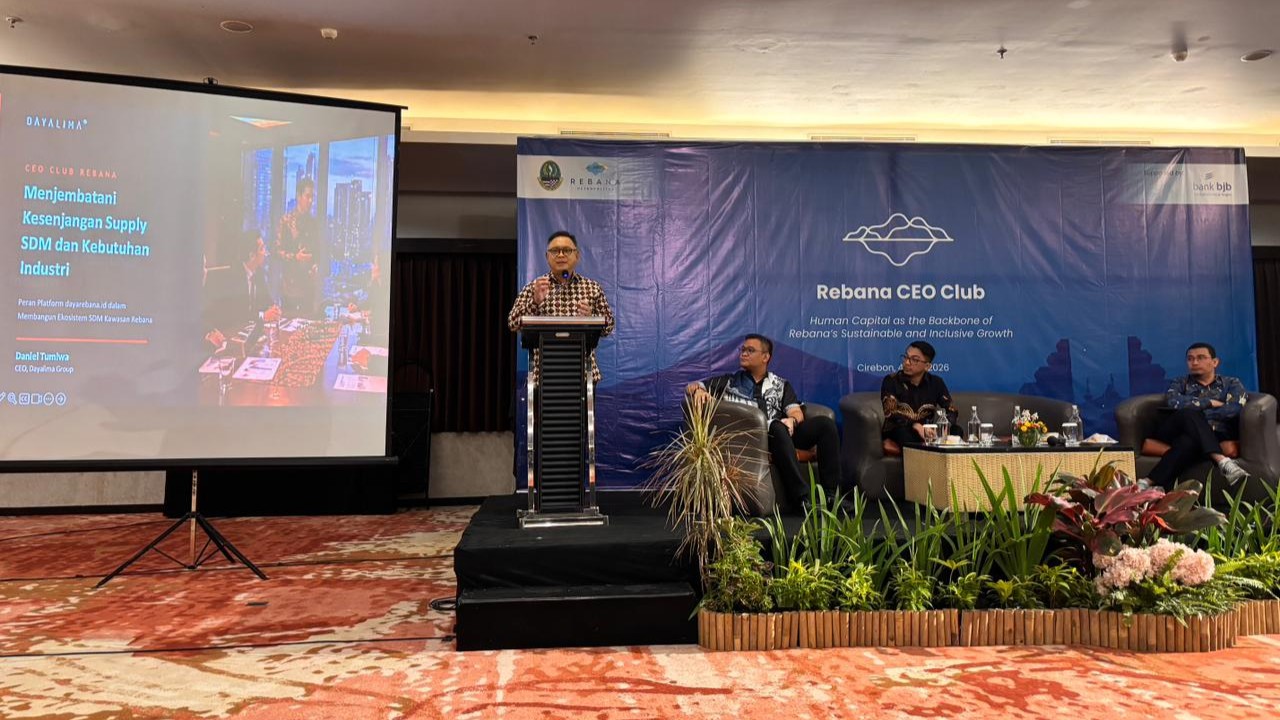
CIREBON – Dayalima Group participated as a panelist at the Rebana CEO Club held on Monday, May 4, 2026, at Aston Cirebon Hotel & Convention Center. Initiated by the Badan Pengelola Kawasan Rebana, the strategic forum brought together leaders from industry, education, and workforce development sectors to discuss the future of the workforce ecosystem in the Rebana region.
Representing Dayalima Group, Daniel Tumiwa delivered insights in a session titled “Bridging the Gap Between Workforce Supply and Industry Needs.” The discussion focused on one of the most pressing challenges in industrial growth today: ensuring that workforce development and talent preparation remain aligned with the rapidly evolving needs of industry.
As the Rebana region continues to grow as one of Indonesia’s emerging industrial corridors, the demand for industry-ready talent is increasing significantly. However, many organizations continue to face challenges related to workforce readiness, skills gaps, employability, and talent acquisition. This highlights the urgent need for a more connected and data-driven talent ecosystem capable of supporting sustainable industrial development.
Strengthening Workforce Development Through a Talent Ecosystem Approach
During the session, Dayalima Group emphasized that workforce development should not only focus on recruitment, but also on building a sustainable talent ecosystem that connects industry demand, educational institutions, workforce planning, and employability initiatives.
A strong talent ecosystem enables organizations to:
- project future workforce needs more accurately,
- identify critical skill requirements,
- improve workforce readiness,
- accelerate employability programs, and
- strengthen long-term talent pipeline development.
According to Dayalima Group, collaboration between industry stakeholders and educational institutions plays a critical role in reducing the gap between workforce supply and industry needs. By aligning curriculum development, employability training, and workforce planning strategies with actual market demand, organizations can build a more scalable and future-ready workforce ecosystem.
Building Workforce Readiness Through Digital and AI-Powered Solutions
One of the key highlights of the discussion was the introduction of the dayarebana.id platform, a digital initiative designed to support workforce planning and talent ecosystem development across the Rebana region.
The platform aims to help industries, educational institutions, and workforce stakeholders collaborate more transparently through:
- workforce demand projection,
- digital recruitment systems,
- employability programs,
- workforce analytics, and
- AI-powered talent readiness initiatives.
By leveraging technology and workforce data, companies can improve recruitment efficiency while minimizing dependency on informal intermediaries. At the same time, educational institutions can better understand industry requirements and prepare graduates with more relevant competencies and employability skills.
This integrated approach supports not only recruitment transformation, but also broader workforce development initiatives that contribute to sustainable economic growth.
Workforce Planning as a Foundation for Industrial Growth
As industrial investment in the Rebana region continues to expand, strategic workforce planning becomes increasingly important for long-term business sustainability. Companies require greater visibility into workforce availability, future skill requirements, and talent supply readiness.
Dayalima Group highlighted that workforce planning is no longer limited to operational hiring needs. Instead, organizations are now expected to develop proactive workforce strategies that anticipate industry transformation, technological disruption, and changing labor market dynamics.
A future-ready workforce ecosystem requires:
- collaboration between industry and education,
- workforce analytics and data transparency,
- scalable employability programs,
- continuous upskilling initiatives, and
- long-term human capital development strategies.
These elements are essential to ensuring that industrial growth is supported by qualified, adaptable, and industry-relevant talent.
Encouraging Collaboration Between Industry, Education, and Government
The discussion at the Rebana CEO Club also reinforced the importance of cross-sector collaboration in strengthening workforce readiness across the region. Sustainable workforce development cannot be achieved by a single institution alone. Instead, it requires active participation from industry leaders, educational institutions, government agencies, and workforce development partners.
By encouraging organizations to contribute workforce demand data and participate in talent development initiatives, the forum demonstrated a shared commitment to building a more inclusive, scalable, and sustainable workforce ecosystem for the future.
The collaboration is expected to help accelerate:
- talent ecosystem development,
- employability improvement,
- workforce transformation,
- recruitment modernization, and
- regional economic competitiveness.
Preparing a Future-Ready Workforce Ecosystem
Through its participation at the Rebana CEO Club, Dayalima Group reaffirmed its commitment to supporting workforce development and talent ecosystem transformation in Indonesia. The company believes that sustainable economic growth depends not only on infrastructure investment, but also on the readiness and quality of human capital behind it.
By integrating workforce planning, employability programs, AI-powered solutions, and strategic collaboration, Dayalima Group continues to support organizations in preparing a future-ready workforce capable of meeting evolving industry demands in the Rebana region and beyond.


